
Initiatives to Enhance Corporate Governance 日本語
Expanding Board Diversity
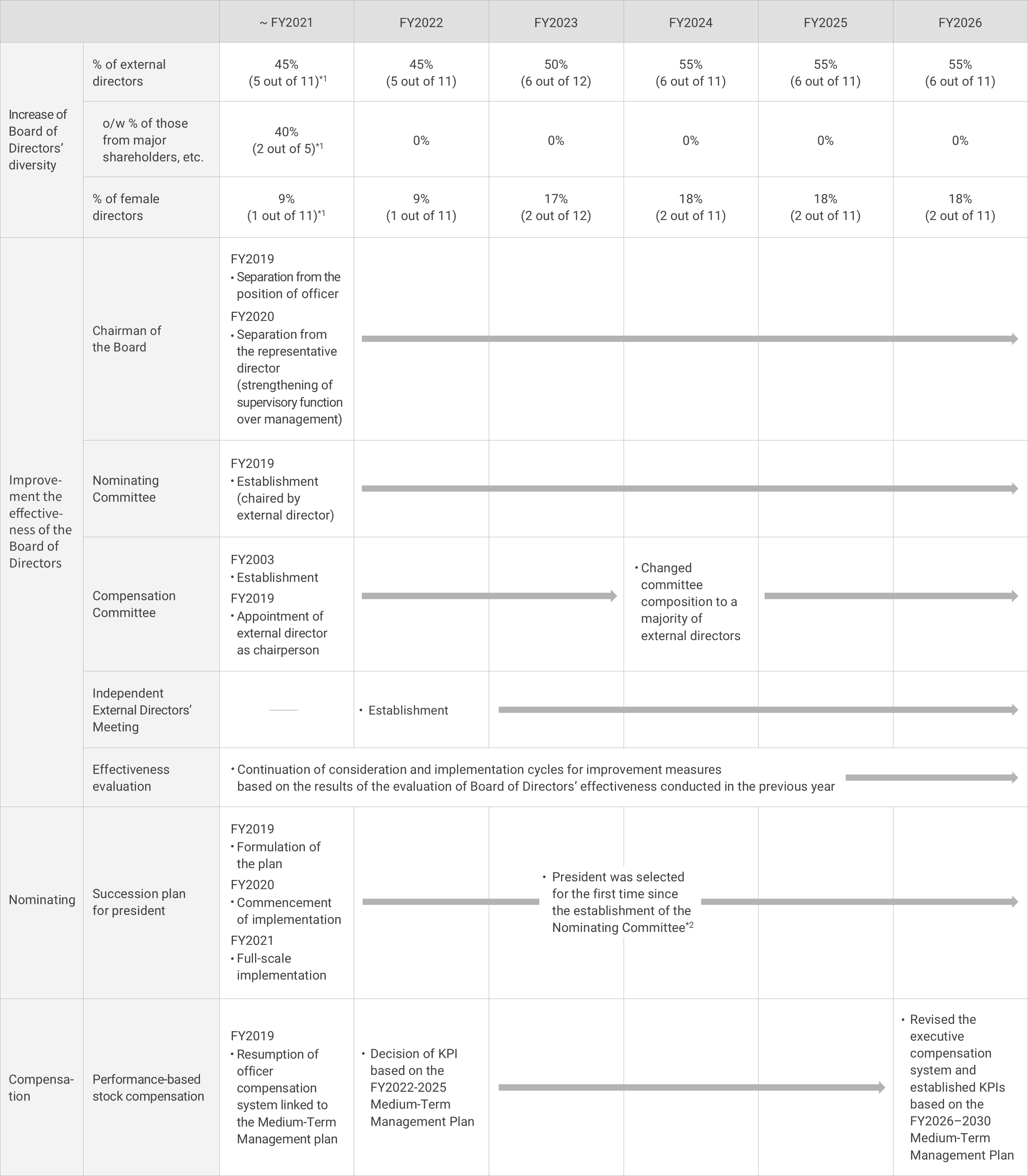
The composition of the Board of Directors is designed to ensure that the Board as a whole can demonstrate its effectiveness, taking into account the need to secure diversity and an appropriate number of members.
Changes in board composition

External Directors as of June 30, 2026
- Takuya Nakata, Chairman of the Board (Chairman of the Board of Directors of Yamaha Corporation)
- Tsuneyoshi Tatsuoka (former Vice Minister of Economy, Trade and Industry)
- Toshihiro Uchiyama (Honorary Advisor of NSK Ltd.)
- Shigeru Murayama, Chair of Audit and Supervisory Committee (former Representative Director and President of Kawasaki Heavy Industries, Ltd.)
- Michiko Chiba, Audit and Supervisory Committee Member (Commissioner of Certified Public Accountants and Auditing Oversight Board)
- Yoko Seki, Audit and Supervisory Committee Member (Attorney at law, Certified Public Accountant)
Enhancement of Board Effectiveness
The Board of Directors is improving its effectiveness through a variety of initiatives.
Chairman of the Board
FY2020: A non-executive director assumed as chairman. (To strengthen operational supervision)
Nominating Committee
As a voluntary advisory body to the Board of Directors, the Nominating Committee primarily formulates criteria for the election and removal of the chief executive officer, president, and directors, nominates candidates, considers the composition of the Board of Directors, and oversees evaluation and assignment of officers, etc.
FY2019: Established the Nominating Committee
FY2020: Started operation of the succession plan for the President
FY2023: President was selected for the first time since the establishment of the Nominating Committee
Committee composition: 3 external directors and 2 internal directors (chaired by an external director)
Compensation Committee
As a voluntary advisory body to the Board of Directors, the Compensation Committee deliberates and makes proposals for policy regarding executive compensation as well as various related systems.
FY2003: Established the Compensation Committee
FY2019: An external director assumed as chairperson.
FY2024: Changed committee composition to a majority of external directors
Committee composition: 3 external directors and 2 internal directors (chaired by an external director)
Independent External Directors' Meeting
External directors freely exchange opinions on the issues and matters to be discussed by the Board of Directors based on an independent and objective standpoint, thereby vitalizing the discussions at the Board of Directors.
FY2022: Established the Independent External Directors' Meeting
Evaluation of the Board of Directors' effectiveness
The Company asks a third-party organization to analyze and evaluate the effectiveness of its Board of Directors in order to further improve its functions. Based on the results of the previous year's evaluations, the Company continues the cycle of studying and implementing improvement measures.
Compensation system and performance-based structure
FY2022: Started applying a new performance-based executive compensation system.
FY2026: Revised the executive compensation system to place greater emphasis on performance-based compensation. (See the table below for an overview of the system.)
The compensation system for Officers, etc. (including Directors who also serve as Officers, etc.) comprises monetary compensation (fixed compensation and bonus) and stock compensation. The standard payment of bonus and stock compensation to be paid to individual Officers, etc. is calculated by multiplying the amount of their respective fixed compensation by a ratio, which is determined according to their respective title and duties. When the ratio of fixed compensation is assumed to be 1, the range of the ratio for the standard payment of each compensation is as shown below.
Stock compensation consists of performance share unit (PSU) compensation and restricted stock unit (RSU) compensation using restricted stock in order to further incentivize Directors and Officers, etc. to achieve the targets set forth in the medium-term management plan, enhance corporate value over the medium to long term, and further promote value sharing with shareholders. The compensation for Non-Executive Directors is fixed compensation only.
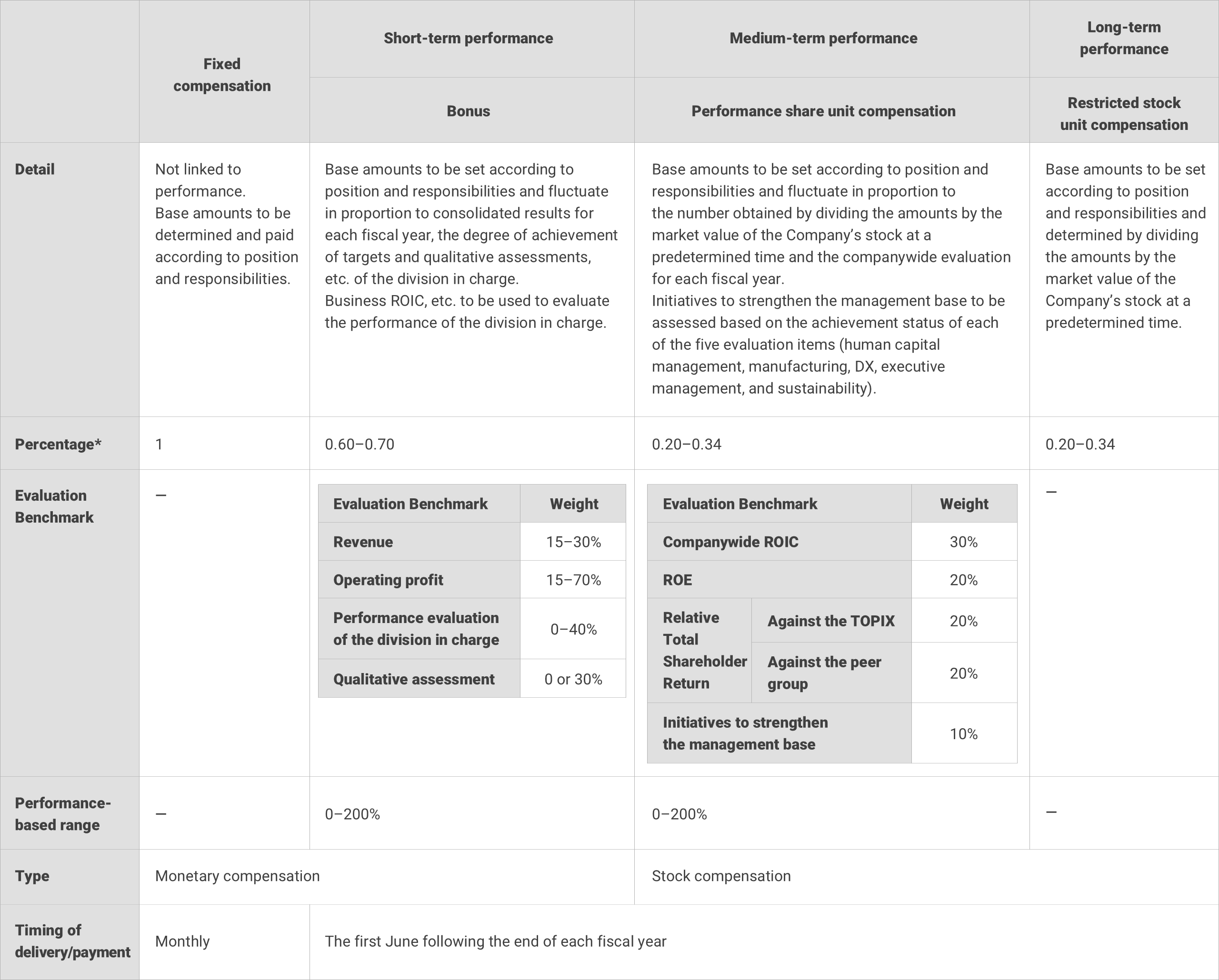
- * is the percentage of each compensation when the fixed compensation is assumed to be 1. The percentage of compensation varies according to position and responsibilities.
- Stock compensation will be delivered to the extent that the share dilution ratio for each fiscal year does not exceed 1%. Disposal is prohibited in principle until their retirement from any of the positions as Director or Officers, etc.
- In the case of retirement due to justifiable reasons before the date of delivery of performance share unit compensation and restricted stock unit compensation or being non-resident of Japan on the date of delivery, cash equivalent to the market value of the restricted stock will be provided instead.
History of Enhancing Corporate Governance
- Composition of the Board of Directors in FY2021
- The change of the president was in April 2024.