Ensuring Quality and Safety

Basic Approach
Ensuring that products and services that are widely utilized in the market are safe to use is an important precondition for the sustainable development of society. As IoT, AI, and other technologies continue to advance, it is necessary to ensure quality not only in terms of product safety, service safety, and environmental considerations, but also in areas such as product security. We also consider it important to respond more actively to changing customer needs that change in line with evolving lifestyles and values.
In response to these growing social demands for quality, the Nikon Group has established in the Basic Quality Policy that we will continue to enhance the value we provide to customers through our products and services, contributing to the healthy development of society. To put this policy into practice, we have also established the Quality Management Directive (QMD), which applies to the Nikon Group as a whole.
Basic Quality Policy
Based on our philosophy of Trustworthiness and Creativity, Nikon has established the following Basic Quality Policy. It aims to increase the value that we provide to customers through our products and services, contributing to the healthy development of society.
- (1)Enhance brand value and provide high-quality distinctive products and services to the market in a timely manner through creative and efficient manufacturing.
- (2)Provide safe and environmentally friendly products and services to earn the trust of customers and society.
Strategy
The Nikon Vision is to become a key technology solutions company in a global society where humans and machines co-create seamlessly. To achieve this vision, we must establish a global quality management system across the entire Nikon Group that ensures the maintenance and improvement of the trust our customers have in our quality. This system also needs to anticipate changes in the values sought by society and customers, as well as technological innovations and shifts in manufacturing.
For this reason, we have created a Quality Manual (QM) based on the QMD for each business unit (including the Group companies). This QMD encompasses the requirements of ISO 9001*, and we are implementing swift and appropriate revisions in response to changes in trends and situations happening around the world. Within the Nikon Group, manufacturing companies are leading the way in obtaining ISO 9001 certification, with approximately 67% of Nikon and Nikon Group manufacturing companies holding this certification (as a ratio to total companies).
We have also established a global quality management system to strengthen our global governance, which includes deploying it to Group companies outside Japan that joined the Nikon Group through M&A. In addition, this initiative includes the reduction of quality risks.
As part of these activities, we introduced major revisions to the QMD in fiscal year 2025 to ensure these Group companies outside Japan practice QMD even more consistently. The Nikon Group strives to improve quality management across the Nikon Group by clarifying the items to be implemented by the Group companies outside Japan as members of the Nikon Group in line with the requirements of ISO 9001.
We also strive to strengthen our culture of quality by establishing a system to improve the level of quality education, form behavioral principles in manufacturing, and ensure product safety and product security in response to technological advances.
Through these efforts, we work to prevent quality issues on an ongoing basis. By undertaking the above, we will build a group-wide quality foundation within the Nikon Group that supports both our proactive prevention system for quality risks and our ability to deliver products that earn customer satisfaction.
- *ISO 9001: An international standard of quality management system established by the International Organization for Standardization (ISO). The ISO 9000 series is a quality management system for organizations to maintain and manage quality. ISO 9001 certification can be obtained from registrars.
Featured
Ensuring Safety of Products and Services
The Nikon Group regards safety as an integral part of the quality of our products and services and works to ensure safety throughout the entire product life cycle, from planning to disposal. Our Basic Quality Policy, QMD, and the rules and procedures of each business unit explicitly require the assurance of safety. We verify operational status through QMD and CMS assessments.
We also require safety evaluations for all products and implement designs that identify and eliminate risks in accordance with the Safety Design Principle Sort, which are based on international standards. In fiscal year 2025, we revised our EMC standards, Wireless Communication Standards, and Industrial Equipment Safety Design Standards. Furthermore, we ensure safety through design reviews at the development and design stages and inspections during mass production, obtaining certification from third-party certification bodies as necessary. The number of serious product accidents* in fiscal year 2025 was zero.
- *Serious product accidents related to safety: Based on the definition of serious product accidents used in the Consumer Product Safety Act.
Product Security
The Nikon Group strengthens security initiatives throughout the product life cycle, from planning to disposal. In fiscal year 2025, we built a systematic product security framework by establishing Nikon-PSIRT* as a cross-functional organization and launching a contact point for reporting product security vulnerabilities.
We also established the PSIRT Product Security Regulations and related implementation rules, enabling each business unit to work with Nikon-PSIRT to implement product-specific countermeasures. We operate a prompt and transparent process for vulnerability management and incident response while strengthening response capabilities through training and talent development.
With regard to AI, we have verified there is no use of prohibited AI systems in any of our business units, as stipulated by the EU Artificial Intelligence Act, which came into effect on August 1, 2024. We will also continue to monitor and assess other categories of AI systems to ensure we provide our customers with safe products.
- *PSIRT: Product Security Incident Response Team
Safety Training for Employees
To ensure the safety of our products and services, the Nikon Group conducts a variety of periodic safety education programs for employees. These programs include training covering the Fundamental Safety Design Principles that define standards of safety design, the Product Liability Act, and the Electrical Appliance and Material Safety Act.
In fiscal year 2025, approximately 1,360 employees of the Nikon Group in Japan participated in the educational training courses held by the Quality Strategy and Management Department of the Product Technology Division and the Technical College. We offered in-person, online, and on-demand training for employees to take and repeat as needed, ensuring retention of safety design knowledge.
Sustainability Report 2026
See the Ensuring Quality and Safety section of our Sustainability Report for more information.

Sustainability Report 2026 Data Index
View data related to our social initiatives.
Featured Highlights
This section details the unique Nikon approach toward creating a sustainable society.

Related Information
Manufacturing | Technology
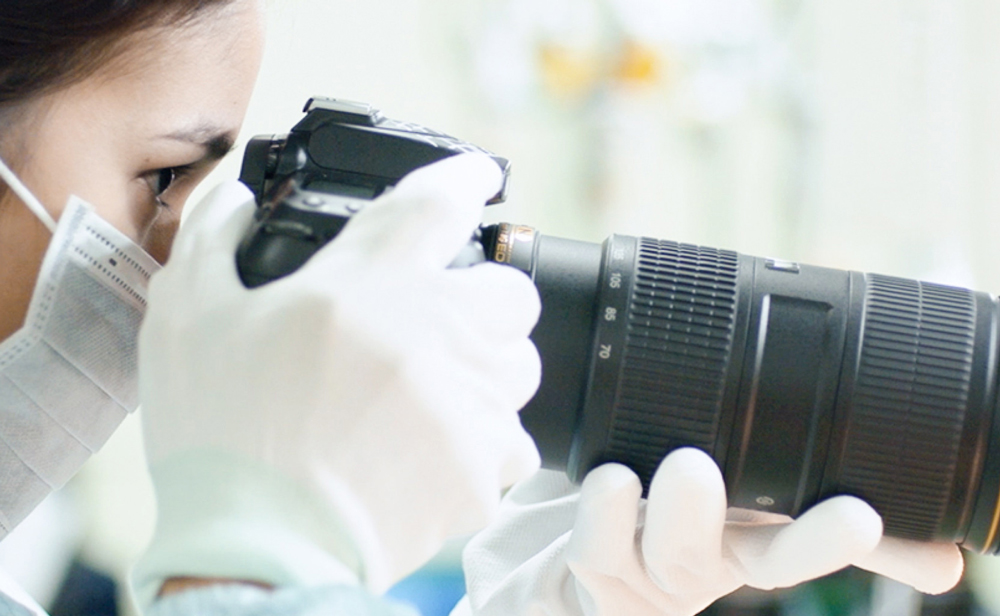
Learn about Nikon’s manufacturing focuses on quality from product planning to production.