
Key Themes

- Key Themes for Creating Value
- Key Themes for Building Trust
- Selection of Key Themes
- Related Information
The Nikon Group identifies materialities to prioritize achieving sustainable growth together with society. We reviewed our materialities in fiscal year 2025 in connection with the formulation of the Medium-Term Management Plan (FY2026-FY2030). In this review, we held extensive discussions on the future vision the Group should pursue based on higher-level policies, including our corporate philosophy, as well as expected changes in the business environment and social issues. We then defined and identified materialities as areas requiring focused attention to achieve that vision.
To avoid confusion with the various definitions of materiality used today, Nikon refers to the newly identified materialities as key themes. These themes consist of three Key Themes for Creating Value and eight Key Themes for Building Trust.
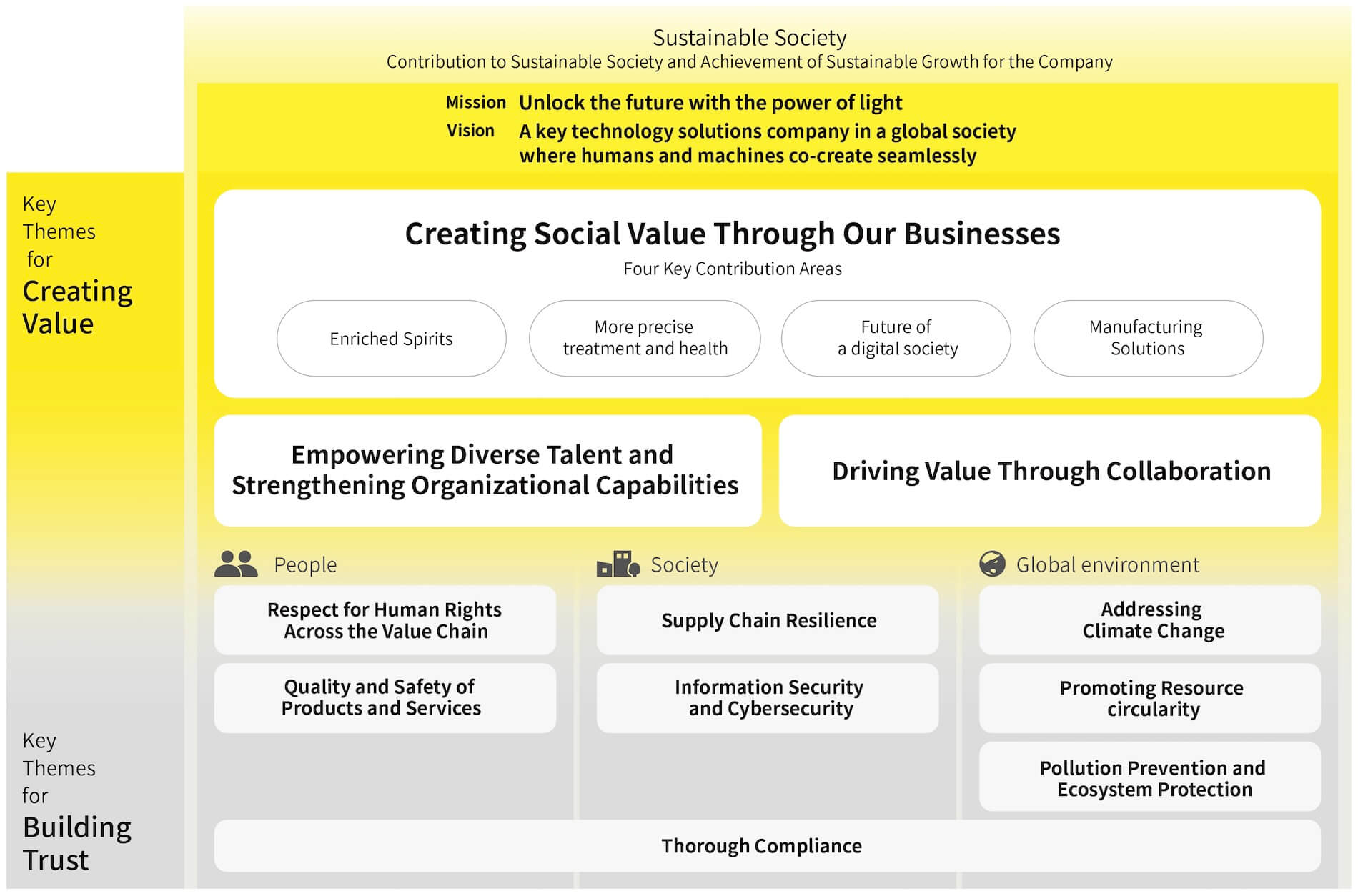
Key Themes for Creating Value
The Key Themes for Creating Value define the areas where the Nikon Group will contribute to creating social value through our businesses. We also clarified key elements for empowering diverse talent and strengthening organization capabilities, two factors essential to value creation, as well as the key elements of partnerships that accelerate and expand value creation. The Nikon Group will manage progress and advance the above initiatives in these key focus areas through our management strategy.
Key Themes for Building Trust
The Key Themes for Building Trust include a defined vision for each theme. Initiatives to address both risks and opportunities are positioned as strategies under each theme and include indicators and targets for each strategy. The Sustainability Committee manages progress against the annual plans for key themes to support steady execution.
Addressing climate change
- Vision
- Achieving net zero throughout the value chain by fiscal year 2050
- Strategy
- GHG emission reduction in Scope 1, 2, and 3 and accelerate introduction of renewable energy
- Indicators: Targets
(Year of Achievement) -
- Scope 1 and 2 reduction (compared to FY2022): 57% (FY2030)
- Scope 3 reduction (compared to FY2022): 25% (FY2030)
- Achieve renewable energy adoption rate of 100% (FY2030)
Related ESG Initiatives
SDGs Contributed To
Promoting resource circularity
- Vision
- Minimizing resource consumption and maximizing resource circulation throughout the value chain
- Strategy
-
- Reducing resource consumption and waste, etc.
- Effective use of water leading to reduced water withdrawal
- Indicators: Targets
(Year of Achievement) -
- Percentage of recycled plastic used in products: 5% or more (FY2030)
- Rate of reduction in total discharged waste (compared to FY2018): 10% or more (FY2030)
- Rate of freshwater consumption reduction (compared to FY2018): 5% (FY2030)
Related ESG Initiatives
SDGs Contributed To
Pollution prevention and ecosystem protection
- Vision
- Zero negative impacts on human health or ecosystems in the value chain
- Strategy
- Appropriate use of chemical substances and reduction of ecological impact and dependence
- Indicators: Targets
(Year of Achievement) -
- Hazardous chemical substances in products: Containing zero (FY2030)
- Zero usage of hazardous chemical substances in manufacturing processes: Use zero (FY2030)
- Percentage of FSC-certified or recycled paper (catalogs, instruction manuals, packaging boxes): 100% (FY2030)
Related ESG Initiatives
SDGs Contributed To
Respect for human rights across the value chain
- Vision
- Establish initiatives to respect the human rights of rights holders* in business activities
- *A rights holder is a person who is the subject of human rights and refers to someone whose human rights are being or may be violated.
- Strategy
- Spreading awareness of human rights via the Nikon Human Rights Policy and conducting human rights due diligence
- Indicators: Targets
(Year of Achievement) -
- Level of awareness of Nikon Human Rights Policy: 100% (FY2030)
- Rate of implementation of human rights due diligence (human rights risk survey and improvement activities) in the Nikon Group: 100% (every fiscal year)
- Level of awareness of Nikon Global EDI Policy: 100% (FY2030)
- Occupational accidents attributable to work or related to the performance of work: 60 cases or less (every fiscal year)
- Percentage of employees with high stress levels (Nikon): Below the previous national average*1 (every fiscal year)
- Average Energy and Work Satisfaction scores (Nikon): Above the previous average*2 (every fiscal year)
- *1Based on data published by the stress check service provider.
- *2Scores use a five-point evaluation scale based on the Ministry of Health, Labour and Welfare conversion table. Scores closer to 5 indicate better conditions, while scores closer to 1 indicate greater challenges.
Related ESG Initiatives
SDGs Contributed To


Supply chain resilience
- Vision
- A sustainable supply chain that addresses business risks and social issues in an appropriate manner
- Strategy
- Building a mechanism for supply chain risk assessments and immediate emergency response
- Indicators: Targets
(Year of Achievement) -
- Percentage of human rights due diligence conducted*1 (critical procurement partners): 100% (FY2030)
- Assess supply chain BCP systems*2 (Tier 2 suppliers of critical procurement partners): 100% (FY2030)
- Understanding supply chain cybersecurity systems: 100% (FY2030)
- *1Conduct until completion of corrective actions when investigations or audits identify the need for corrective action.
- *2The scope of the supply chain requiring BCP system establishment is managed based on the number of suppliers.
Related ESG Initiatives
SDGs Contributed To
Quality and safety of products and services
- Vision
- Providing high-quality, competitive products and services that are safe, environmentally friendly, and secure
- Strategy
- Advancement and establishment of quality management
- Indicators: Targets
(Year of Achievement) -
- Number of product recalls: 0 (every fiscal year)
- Degree of achievement of the plan to review the quality management system in response to changes in the business environment: 100% (every fiscal year)
- Level of understanding of basic training on quality (business units, Group manufacturing companies): 80% or more (every fiscal year)
Related ESG Initiatives
SDGs Contributed To
Information security and cybersecurity
- Vision
- Establishment of global security controls and cyber resilience
- Strategy
- Continuous enhancement of cyber resilience through proactive risk management and a Zero Trust-based governance approach
- Indicators: Targets
(Year of Achievement) -
- Number of days of business suspension caused by major cyber incidents with serious impacts on business continuity: 0 (every fiscal year)
- Achievement rate of target maturity levels based on global security standards (including the NIST CSF): 95% (FY2030)
- Reporting rate for suspicious emails in phishing simulation training: 70% or more (FY2030)
Related ESG Initiatives
SDGs Contributed To
Thorough compliance
- Vision
- Zero compliance violations
- Strategy
- Spreading awareness of the Nikon Code of Conduct
- Indicators: Targets
(Year of Achievement) -
- Establishment of compliance awareness*: 95% or more (every fiscal year)
- Awareness level of whistleblower system*: 95% or more (every fiscal year)
- *Checked by Nikon Group awareness surveys.
Related ESG Initiatives
SDGs Contributed To
Selection of Key Themes
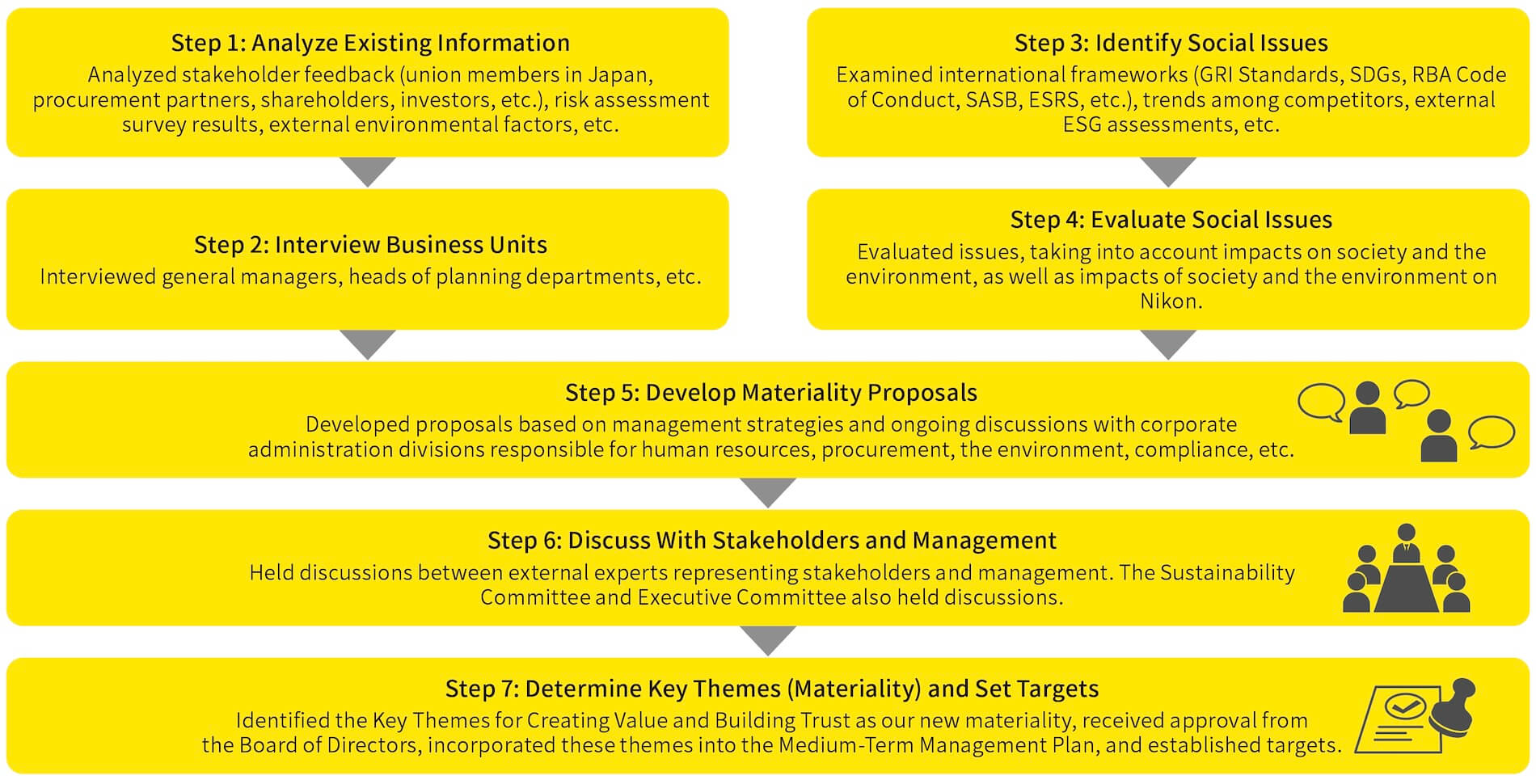
Our analysis drew on feedback gathered through ongoing communication with stakeholders, risks identified by the Risk Management and Compliance Committee, and the external environment. We also interviewed general managers and heads of planning departments across each business unit. Furthermore, we compiled a list of 33 items based on issues identified using international frameworks, including the GRI Standards, SDGs, RBA Code of Conduct, SASB, and ESRS, as well as competitor trends and external ESG assessments. We then evaluated these items from both perspectives of the impact the Nikon Group has on society and the environment, as well as and the impact society and the environment have on the Nikon Group. We developed a proposed set of materialities through extensive discussions with corporate administration divisions responsible for management strategy, human resources, procurement, the environment, and compliance, taking into account out efforts listed above. We then discussed the proposed materialities with external experts and held management-level deliberations through the Executive Committee and other meetings. The Sustainability Committee selected the final materialities and received approval at the Board of Directors.
Steps to Identify Key Themes (Materiality)
Sustainability Report 2026
See the Sustainability Management section of our Sustainability Report for more information.

Related Information
Highlights

This section details the unique Nikon approach toward creating a sustainable society.