Protection of Water Resources

Basic Approach
Large quantities of water are used in the production processes for optical lenses, part of Nikon's main product category, and for the quartz glass used in these lenses. For example, during the optical lens polishing process, water has to be added frequently in order to keep the polishing agent at the right consistency. Similarly, in the quartz glass production process, our waste gas purification devices require water to remove acid components from waste gases.
For these reasons, water is not only an indispensable resource for Nikon Group business, but it also affects the global environment through water discharge and other means. Working to conserve water resources is therefore essential for business continuity.
The Nikon Group formulated the Nikon Long-Term Environmental Vision looking ahead to fiscal year 2050. Of the three pillars, realizing a resource circulating society depicts our vision for water and resources, while realizing a healthy and environmentally safe society corresponds to our vision for water safety. To achieve these goals, the Nikon Environmental Policy stipulates the conduct of regular water risk assessments, monitoring of water withdrawal, proactive water reuse, and the establishment and compliance of voluntary standards exceeding legal requirements. In this way, we reduce our environmental impact stemming from water use to the greatest extent possible.
In addition, we aim to implement steady initiatives and improve standards through employee training on water-related initiatives and related laws and regulations as part of employee environmental education.
Related Policies

Strategy
To conserve water resources, the Nikon Group monitors the amount of water withdrawal, discharge, and reuse, implementing proactive initiatives for effective water use. Beginning in fiscal year 2021, the Group also introduced a new freshwater consumption indicator*, as we believe it is important that water used should be returned at an equal or better quality than when it was withdrawn. The Nikon Group believes that reducing freshwater consumption leads to a reduction in the load on water withdrawal in each region. We also believe reducing freshwater consumption leads directly to reduced water-related costs, such as water supply costs.
In addition, Nikon Group production sites have created a water balance sheet to visualize water balance and usage according to process for the purpose of efficient and effective water use. Through these efforts, the Nikon Group identifies opportunities for water conservation, reuse, etc., and implements improvement measures accordingly.
For fiscal year 2025, the Nikon Group reduced freshwater consumption by 10.6% to 1,678,000 m3, achieving our Environmental Action Plan goals for the fiscal year to reduce water withdrawal by at least 3% compared with fiscal year 2018.
- *Freshwater consumption: Sum of withdrawal volumes A, B, and C, minus returned water volume D (A+B+C-D).
A: Water withdrawal from municipal water supply facilities (tap water, industrial water, etc.)
B: Water withdrawal from surface water (lakes, rivers, etc.)
C: Water withdrawal from groundwater
D: Return water of equal or better quality than the withdrawal source (applicable to B and C only)
Featured
Water Reuse Measures in Production Processes
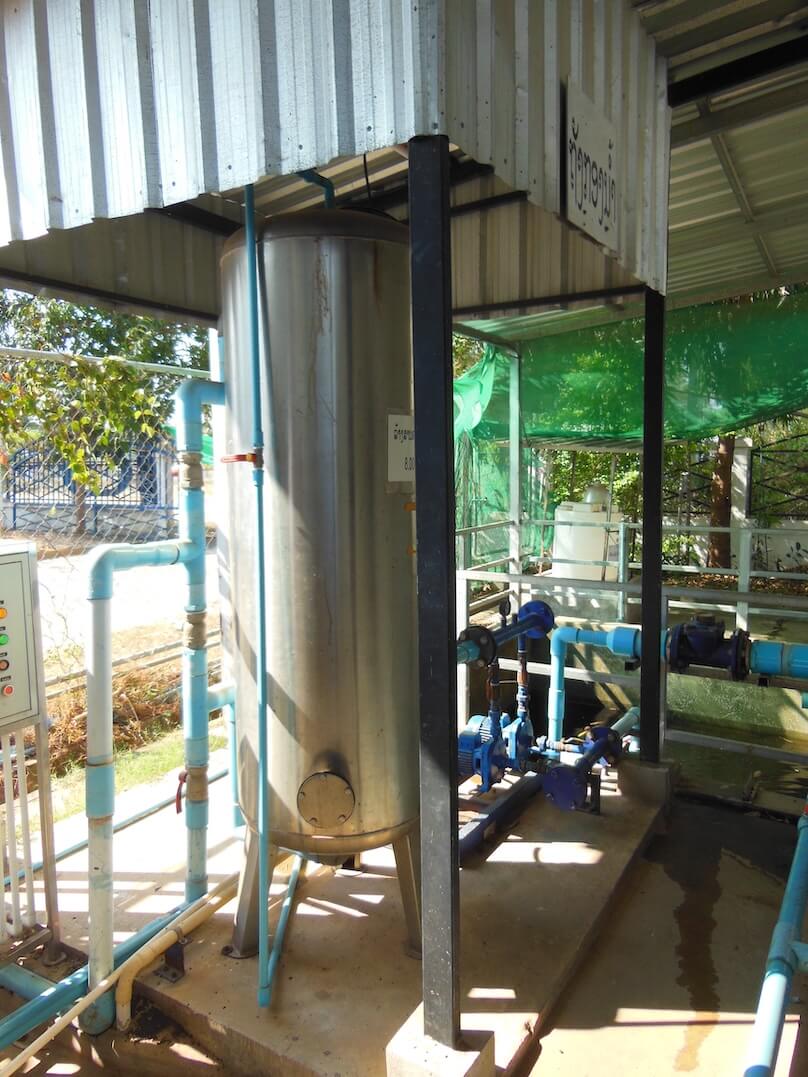
The Nikon Group properly treats wastewater generated during production and actively reuses the treated water.
When manufacturing photomask substrates, the Nikon Shonan Branch uses a large amount of water during the polishing and cleaning processes. Accordingly, the Nikon Shonan Branch implements a mechanism to reuse the wastewater from the cleaning process as supply water for pure water production equipment. In fiscal year 2025, the site reused approximately 9,600 m3 of water discharge annually, reducing water withdrawal by approximately 7.9% compared with water withdrawal prior to adoption.
Nikon Kumagaya Plant, which manufactures semiconductor lithography systems, reuses concentrated water generated during ultrapure water manufacturing processes as make-up water for cooling towers. The plant expanded the number of cooling towers using the reused water in 2020 and reused approximately 38,000 m3 in fiscal year 2025. This volume represented approximately 12% of total water withdrawal at the plant.
Nikon Lao Co., Ltd. (Laos) is located in a district with only basic water supply infrastructure, and has been actively implementing measures to improve water efficiency. The company purifies domestic wastewater for reuse in flushing toilets and in the company garden sprinkler system. Nikon Lao also reuses treated water as a coolant.
Sustainability Report 2026
See the Protection of Water Resources section of our Sustainability Report for more information.

Sustainability Report 2026 Data Index
View data related to our environmental initiatives.