Environmental Management

Basic Approach
The effects of climate change are becoming more pronounced, leading to increasingly severe social and economic losses and damages. The deliverable of the global stocktake, an assessment of global climate change action, reaffirmed the urgent need for action to achieve the 1.5℃ target. The document included emission reductions for all greenhouse gases across various sectors, including industry, transportation, and households, as well as contributions by field.
Simultaneously, there is a need to shift away from the traditional linear economy characterized by a cycle of mass production, consumption, and waste generation toward a circular economy in which resources are recycled and reused. In addition, with regard to chemical substances in products, there has been a steady expansion in the scope of substances that are subject to regulation, as well as in the geographical areas in which such regulations apply.
Companies will be asked to further their efforts to conduct information disclosures based on the TNFD* framework and perform nature-related risk and opportunity assessments toward becoming Nature Positive by 2030, a movement to halt biodiversity loss and put nature on a recovery track.
The Nikon Long-Term Environmental Vision stipulates our three pillars of Realizing a Decarbonized Society, Realizing a Resource Circulating Society, and Realizing a Healthy and Environmentally Safe Society. Under this vision, the Nikon Group contributes to building a sustainable society by balancing environmental responsibility with business growth.
- *TNFD: Abbreviation for Taskforce on Nature-related Financial Disclosures. The Task Force on Nature-related Financial Disclosures aims to build a framework for companies and organizations to assess and disclose the impact of economic activities on the natural environment and biodiversity.
Strategy
The Nikon Group established the Sustainability Policy, which aims to contribute to sustainable societies and achieve sustainable growth for the company, and the Nikon Environmental Policy, a specific policy regarding the environment. Under these policies, we formulated the Nikon Long-Term Environmental Vision as a means to address environmental risks and regulations proactively, targeting fiscal year 2050.
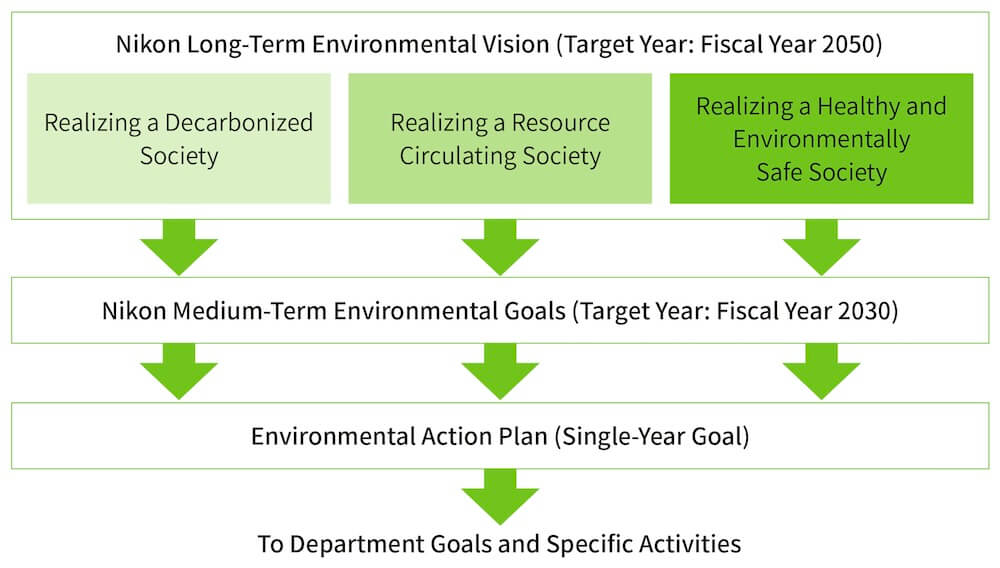
The Nikon Long-Term Environmental Vision comprises three pillars believed to be particularly important in consideration of the global situation and the characteristics of Nikon's business, which uses limited resources to manufacture and sell products. These three pillars are linked with Key Themes and the Nikon Medium-Term Environmental Goals, which targets fiscal year 2030. Our Environmental Action Plan is a single-year goal that we are rolling out across the Group. We clarify the relationship between the environment and our business activities and then make an accurate assessment of the impacts and risks posed to the environment, using this information to prioritize goals and plans.
The Environmental Subcommittee reviews and approves self-evaluations of performance, identifies issues, and incorporates these issues into activities for the following year and thereafter.
Related Policies

Nikon Long-Term Environmental Vision (Target Period: Fiscal Year 2050)
The Nikon Group contributes to building a sustainable society through the Nikon Long-Term Environmental Vision, established for Realizing a Decarbonized Society, Realizing a Resource Circulating Society, and Realizing a Healthy and Environmentally Safe Society. The Nikon Group is committed to developing new businesses and tackling innovations that will contribute to reducing environmental impacts.
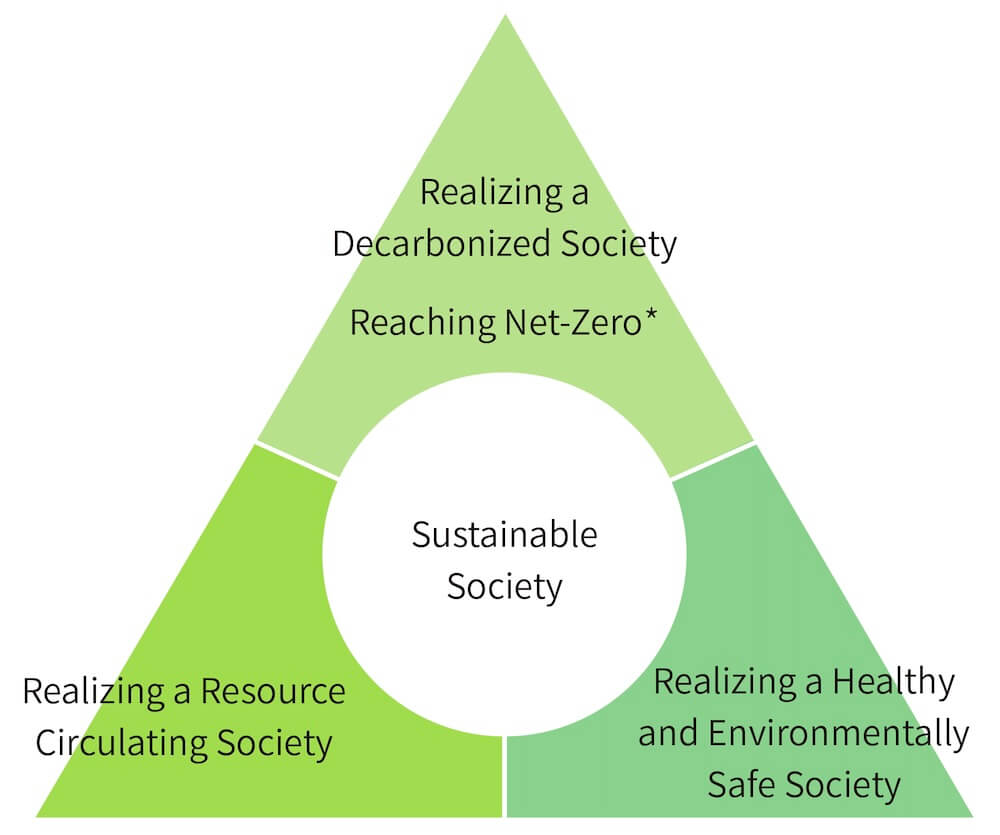
- *90% reduction of GHG emissions (Scope 1, 2, and 3) throughout the value chain, with the remaining emissions neutralized according to internationally recognized criteria.
Nikon Environmental Goal Relationship Diagram
Featured
Environmental Management Based on ISO 14001
The Nikon Group conducts environmental management in accordance with ISO 14001 and aims to have all manufacturing Group companies certified under this standard. We will continue to use the ISO 14001 system and promote environmental management integrated with our business activities by introducing mechanisms for mitigating environmental impacts while maintaining a clear understanding of both internal and external circumstances.
As part of this effort, the Nikon Group conducts HQ EMS Assessments for the top management and EMS Secretariat of each region, and Local EMS Assessments for organizations within each region. We conduct each of these assessments once a year and continuously make improvements to ensure conformity with ISO 14001 and enhance environmental performance. HQ EMS Assessments are conducted by EMS assessors qualified by JRCA* or persons with EMS management experience as a regional secretariat.
To maintain and improve the quality of these EMS assessments, the Nikon Group in Japan conducts EMS assessor cultivation training four times a year. A total of 163 employees completed this training in fiscal year 2025. Employees that have completed this training are tasked with conducting Local EMS Assessments. In addition, the Nikon Group in Japan invites external lecturers to conduct training on laws and regulations related to the environment twice a year. This training aims to improve understanding of environmental regulations and keep employees up to date on regulatory developments. A total of 191 employees completed this training in fiscal year 2025. We are also developing EMS assessors at Group companies outside Japan through participation in training programs run by auditing organizations.
- *JRCA: A certification and registration body for management auditors established within the Japanese Registration of Certificated Auditors and experts. The body registers certification of ISO management system auditors and internal auditors.
Environmental Awareness-Raising Activities
The Nikon Group conducts a range of ongoing environmental awareness-raising initiatives, including e-learning programs for employees.
In fiscal year 2025, the Group provided e-learning on climate change prevention and the circular economy. The Group also marked World Environment Day on June 5 by delivering a message from the responsible officer, hosting an environmental seminar with a guest speaker, and presenting environmental awareness-raising slideshow videos on internal digital signage.
These efforts deepen understanding of environmental issues and encourage employees to reflect on their actions and apply them in their daily work and behavior.
Sustainability Report 2026
See the Environmental Management section of our Sustainability Report for more information.

Sustainability Report 2026 Data Index
View data related to our environmental initiatives.
Related Information
Environmental Actions at Business Facilities

We undertake a wide range of initiatives to conserve biodiversity and preserve the natural environment in our local communities.