Sustainability Management
- Basic Approach
- Sustainability Strategy
- Stakeholder Engagement
- Sustainability Promotion System
- Related Information
Basic Approach
The Nikon Group defines sustainability as contributing to a sustainable society while achieving sustainable growth through business activities grounded in our philosophy of Trustworthiness and Creativity. The Board of Directors adopted the Sustainability Policy, which consists of this core principle and four supporting commitments.
Under this policy, the Nikon Group has established the Nikon Code of Conduct, which embodies Nikon's basic approach to social responsibility and lays down standards for employees to follow when taking actions based on this approach.
Sustainability Policy
The Nikon Group aims to both contribute to a sustainable society and achieve sustainable growth for itself by putting into practice the Nikon philosophy of Trustworthiness and Creativity through our business activities.
- We are committed to helping solve environmental and social challenges and achieve Sustainable Development Goals (SDGs) through our business activities by delivering uniquely Nikon products and services.
- We aim to do better for the environment and for society by objectively assessing the impact our business has on the environment and society and continually striving to make improvements.
- Through active dialog with our stakeholders, we stay abreast of changes in society. We also constantly reflect on our own activities to meet stakeholder expectations.
- We do more than what is required to comply with laws and regulations. We act with integrity and fairness and disclose information appropriately.
Sustainability Strategy
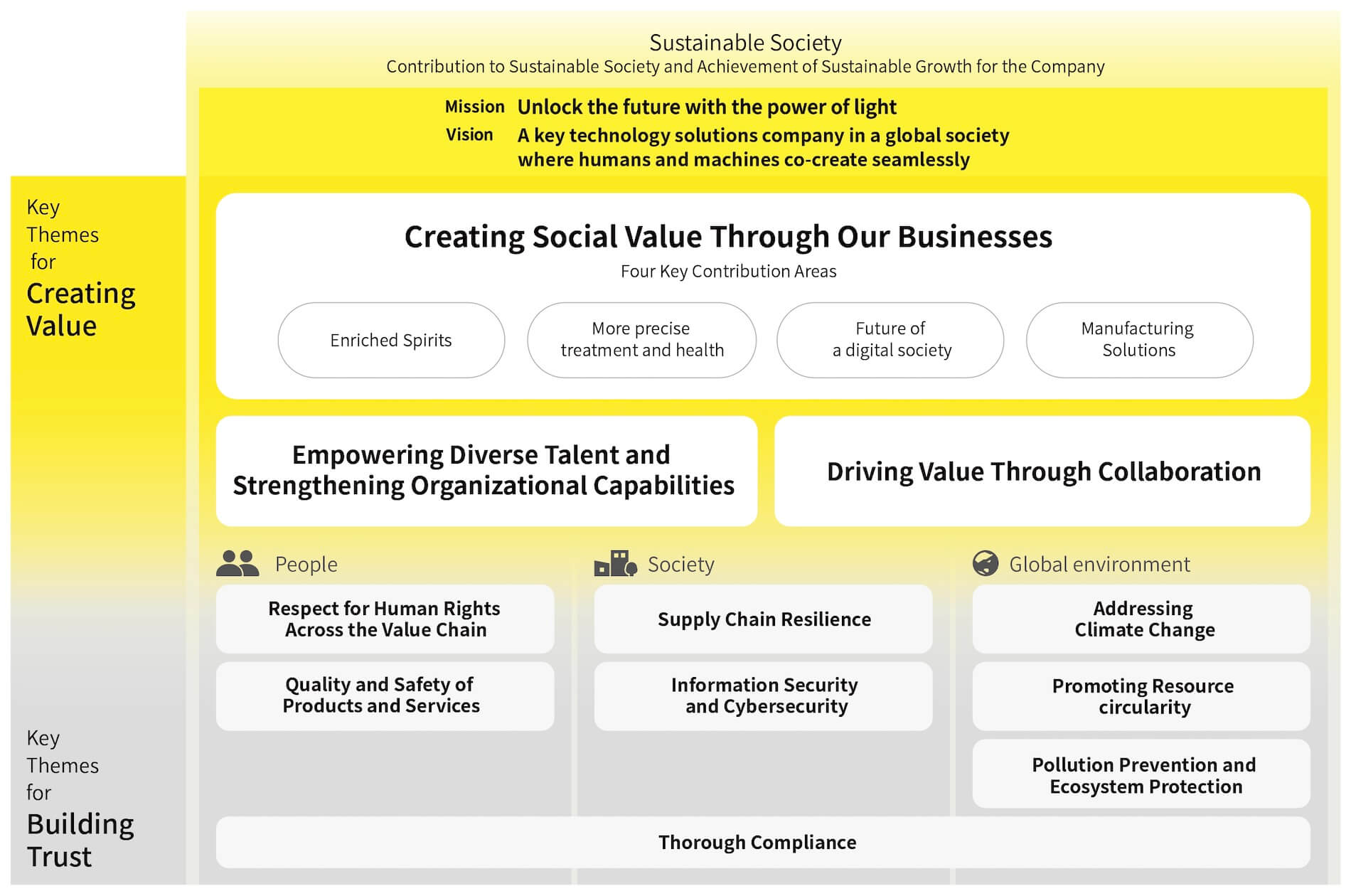
The Nikon Group's Vision is to become a key technology solutions company in a global society where humans and machines co-create seamlessly. We aim to achieve sustainable growth by focusing on creating new value through products and services that contribute to a society where humans and machines co-create seamlessly.
Based on this concept, the Nikon Group formulates sustainability strategies in medium-term management plans and annual plans that support implementation of the Sustainability Policy. The Medium-Term Management Plan (FY2026-FY2030), launched in April 2026, emphasizes sustainability-focused management.
Specifically, the plan sets out Key Themes for Creating Value linked to business and pursues related initiatives. The plan also identifies Key Themes for Building Trust to support value creation, address challenges related to people, society, and the global environment, and fulfill our responsibilities as a member of a sustainable society. In addition to key themes, the Medium-Term Management Plan also sets out our Vision, strategies, indicators, and targets.
The Nikon Group is committed to steadily advancing these initiatives to contribute to a sustainable society while achieving sustainable growth under the Sustainability Policy.
Stakeholder Engagement
The Nikon Group believes that stakeholder engagement is important to properly understand and identify sustainability risks and opportunities, as well as to objectively evaluate and improve overall sustainability efforts, including strategies, indicators, targets, and performance.
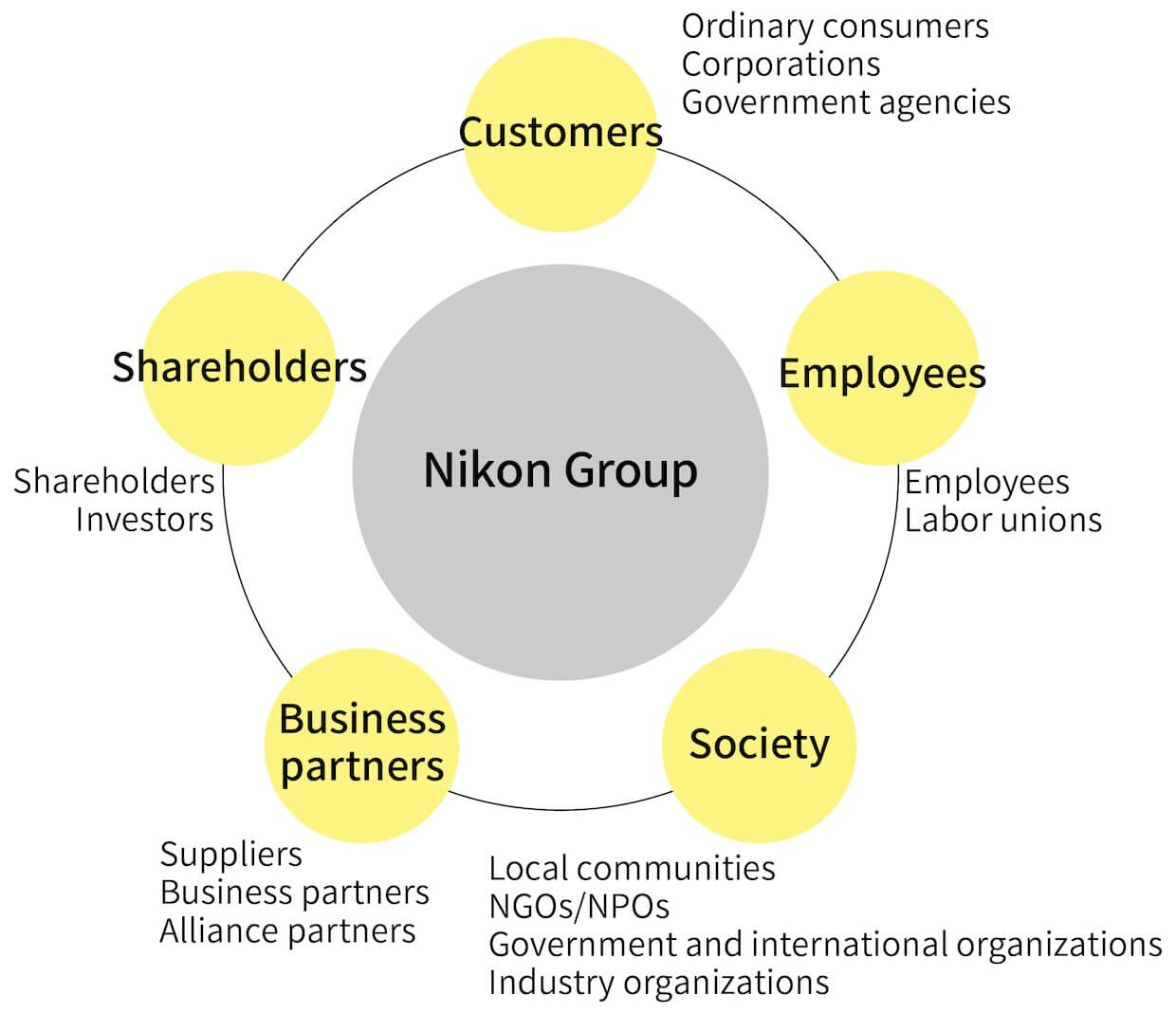
Therefore, we disclose policies and results to Nikon Group stakeholders, including customers, shareholders, employees, business partners, and society at large, conducting disclosure through a variety of opportunities and methods. We take opinions and expectations received in response into consideration. As examples where we listen to stakeholder feedback, management communicates directly with customers in business meetings, with shareholders and investors during investor relations activities, with employees in town hall meetings and labor-management council meetings, and with business partners in procurement partner meetings. In addition, the IR department regularly shares the content of dialogues with shareholders and investors at meetings of the Board of Directors and the Executive Committee.
The opinions of stakeholders collected and analyzed by each department are also reported to the directors in charge and the Executive Committee as appropriate, and subsequently utilized in management and business activities.In this way, the Nikon Group strives to foster sound relationships with stakeholders and engage actively through two-way communication.
Nikon Group's Main Stakeholders
Sustainability Promotion System
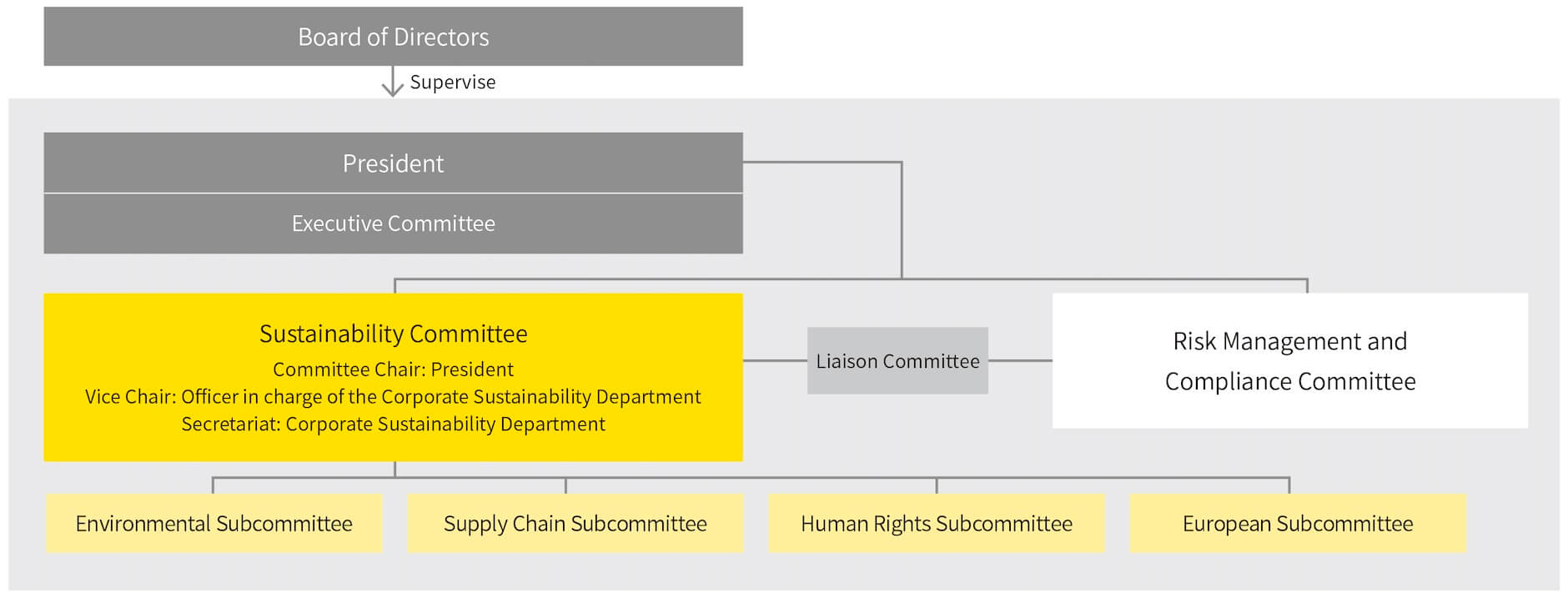
The Nikon Group established the Sustainability Committee, chaired by the president, to implement the Sustainability Policy throughout the Group and to advance our sustainability initiatives consistently. The vice chair is the officer in charge of the Corporate Sustainability Department, while the committee members consist of all Executive Committee members and all general managers responsible as heads of the business units and divisions. Audit and Supervisory Committee members also participate as observers.
The Sustainability Committee, which meets twice per year as a rule, deliberates and manages overall sustainability activities, including the review of materiality (referred to as key themes beginning in fiscal year 2026). The committee also sets strategies and targets for these issues, manages the progress of each initiative, evaluates performance, and directs improvements, while monitoring sustainability-related risks and opportunities with an emphasis on key themes.
The Environmental Subcommittee and Supply Chain Subcommittee are organized under the Sustainability Committee. In April 2026, we established the European Subcommittee to strengthen our response to the rapid development of sustainability-related regulations in Europe. These subcommittees examine specific initiatives and submit reports on activities to the Sustainability Committee once per year and as needed.
We also established a liaison meeting with the Risk Management and Compliance Committee, which has jurisdiction over all Nikon Group risks, for sustainability-related risk management. This liaison meeting shares information regularly and cooperates to address risks.
The Board of Directors receives reports of the activities of these committees at least once a year. In turn, the Board supervises the appropriateness, effectiveness, and risks of various sustainability activities, including those related to climate change.
Sustainability Promotion System (As of April 01, 2026)
Sustainability Report 2026
See the Sustainability Management section of our Sustainability Report for more information.

Related Information
Corporate Governance | Investor Relations

The Nikon Group is establishing the basic policy in internal control system, in order to ensure effective and efficient operations, reliable financial reporting, and preservation of assets, in addition to compliance with relevant laws and regulations.
Business and Other Risks | Investor Relations

Principal matters considered to be likely risk factors in the promotion of business operations.
Sustainability-related Policies

Explore our sustainability policies, including basic policies and guidelines on environmental, social, and governance (ESG) matters.